
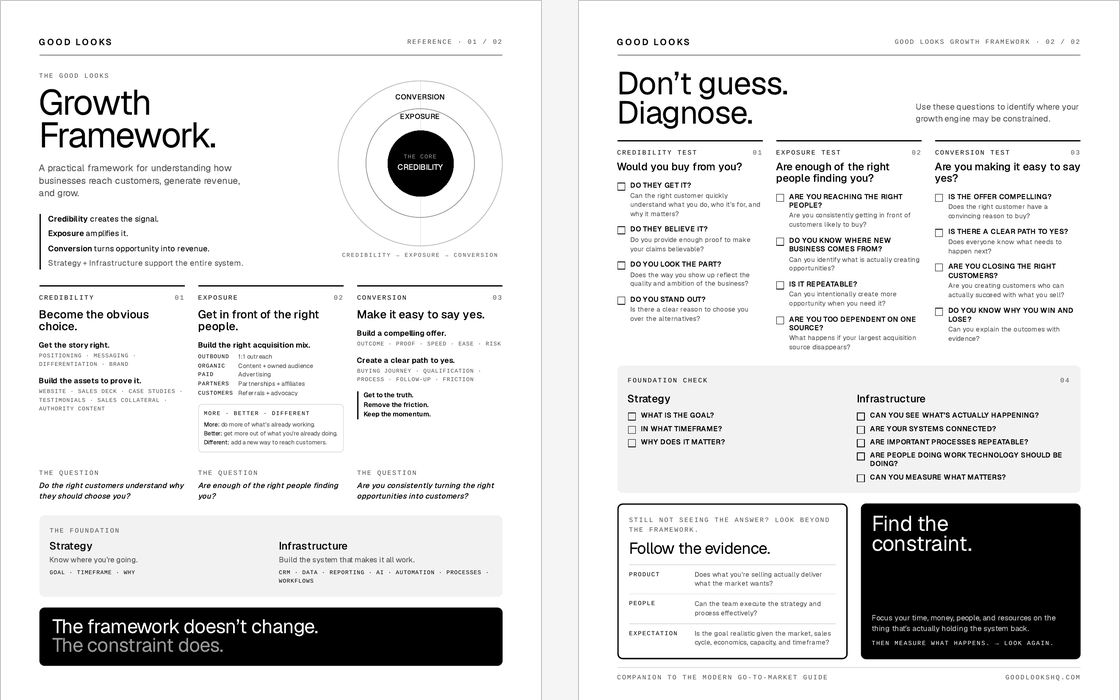
KEEP THE FRAMEWORK HANDY.
We created a two-page companion to this guide with the complete Good Looks Growth Framework on one side and the diagnostic questions on the other.
Download it. Print it. Share it with your team. Use it as you work through the guide.
Download the frameworkSummary
Growing a business has never come with more options, more channels, more tools, more technology, more tactics, and more things competing for your attention. The challenge is figuring out what actually matters for your business and where to focus next.
This guide provides a practical way to think about modern go-to-market and introduces the Good Looks Growth Framework: Credibility, Exposure, and Conversion, supported by Strategy and Infrastructure.
We’ll explore how each part works, how they influence one another, and how to identify the constraint holding your business back before deciding what to do next.
A practical guide to how businesses reach customers, generate revenue, and grow.
For most of business history, the different functions responsible for growth have been treated as separate disciplines.
Product built the product. Marketing generated awareness. Sales closed customers. Customer success took care of them. IT managed the technology. Creative made things look good.
Each function had its own team, its own tools, its own metrics, and often its own strategy.
That model made more sense when the ways businesses reached customers were relatively limited and each function operated within a clearly defined lane.
Today, those lines are disappearing.
A piece of content can build a brand, generate demand, educate a prospect, support a salesperson, rank in search, appear in an AI answer, and influence a buying decision, all at the same time.
Your website is simultaneously a brand asset, a salesperson, a distribution channel, a source of customer data, and increasingly something both humans and AI systems use to understand your company.
AI is changing how content gets created, how prospects research products, how sales teams work, how companies automate processes, and how customers discover businesses in the first place.
The number of channels, tools, technologies, and tactics available to the average company has exploded.
The problem is no longer a lack of things you could be doing.
It's figuring out what you should be doing, and how all of those things work together.
That is the problem go-to-market is meant to solve.
What does “go-to-market” actually mean?
Go-to-market, or GTM, has become one of the most widely used terms in business. It is also one of the most inconsistently defined.
Sometimes it is used as another word for sales. Sometimes it means marketing. Sometimes it refers specifically to launching a new product.
We use it more broadly.
Go-to-market is the system a company uses to reach its target customers, turn them into customers, and ultimately drive revenue and growth.
That system crosses traditional departmental boundaries.
It includes the product you're selling and how it is positioned. The brand and creative that shape how people perceive it. The marketing and media that create demand. The sales process that turns demand into revenue. The customer experience that creates retention and advocacy. And the technology, data, AI, automation, and infrastructure that connect and support all of it.
Product. Creative. Marketing. Sales. Customer Success. Technology.
Different disciplines. One system.
This is why GTM has become such a useful way to think about growth.
The customer doesn't experience your organizational chart.
They don't separate your brand from your website, your website from your product, your marketing from your sales process, or your salesperson from the experience that comes after the sale.
They experience one company.
And increasingly, the companies that grow most effectively are the ones that understand how these functions influence one another.
A better marketing campaign can't fix an offer nobody wants. More leads won't solve a sales process that can't convert them. Great salespeople can only compensate for weak positioning for so long. More content won't help if the content isn't convincing. New AI tools won't fix a strategy that isn't clear.
Growth is the output of the system, not any one department.
Why this matters more now than ever.
There have never been more ways to reach a customer.
That should make growth easier.
In many ways, it has made it more complicated.
A business today can invest in outbound sales, search, social media, paid advertising, creators, partnerships, affiliates, email, events, communities, podcasts, video, AI search, traditional media, referrals, and dozens of other channels.
At the same time, thousands of software and AI products promise to automate, optimize, accelerate, or replace pieces of the process.
The natural response is to keep adding.
Another channel. Another tool. Another campaign. Another salesperson. Another agency. Another AI product.
But more isn't always better.
Every additional tactic creates another thing to execute, measure, manage, and connect to everything else.
The companies that win won't necessarily be the companies doing the most. They'll be the companies that understand what matters for their business, how the pieces work together, and where to focus next.
That requires looking at growth as a system.
That’s the purpose of this guide.
And to make that system easier to understand, we’ll use a simple model throughout:
The Good Looks Growth Framework.
CONVERSION
EXPOSURE
THE CORE
CREDIBILITY
CREDIBILITY → EXPOSURE → CONVERSION
FOUNDATION
STRATEGY + INFRASTRUCTURE
THREE PARTS OF GROWTH.
Credibility
Become the obvious choice.
Exposure
Get in front of the right people.
Conversion
Make it easy to say yes.
Strategy and infrastructure form the foundation that supports every part of the framework.
HOW THE FRAMEWORK WORKS.
At its core, every business needs to accomplish three things to grow.
It needs to give the right customers a compelling reason to choose it. It needs to get in front of enough of those customers. And it needs to turn that opportunity into revenue.
That’s Credibility, Exposure, and Conversion.
These aren’t separate departments or independent strategies. They are interconnected parts of the same growth engine, and the performance of one directly affects the value of the others.
Exposure without credibility simply puts an unconvincing business in front of more people. Credibility without exposure creates a great business that too few people know exists. And credibility and exposure without conversion create opportunity that never becomes revenue.
The goal, then, isn’t to maximize any one part of the framework.
It’s to understand which part of the system is currently limiting the others.
That distinction matters because businesses have a natural tendency to prescribe solutions before diagnosing problems.
When revenue slows, the answer becomes “we need more leads.” When leads aren’t converting, the answer becomes “we need better salespeople.” When marketing isn’t working, the answer becomes “we need more content.” When growth feels inefficient, the answer becomes “we need AI.”
Sometimes those things are true.
Sometimes they’re not.
A business with a credibility problem doesn’t necessarily need more exposure. A business with a conversion problem doesn’t necessarily need more leads. And a business with an unclear strategy doesn’t necessarily need another tactic at all.
The right next move depends on where the constraint is.
That’s the purpose of the framework: not to tell every company to do the same things, but to give businesses a simple way to understand where to look before deciding what to do next.
MORE ISN’T ALWAYS BETTER.
Growth comes from strengthening the system, not maximizing one part in isolation. Start with the constraint.
01 / HIGH EXPOSURE × LOW CREDIBILITY
YOU’RE AMPLIFYING THE WRONG SIGNAL.
More attention means more people experiencing something that isn’t convincing.
02 / HIGH CREDIBILITY × LOW EXPOSURE
YOU’RE THE BEST-KEPT SECRET.
Your business is convincing. The reach isn’t there yet.
03 / HIGH CREDIBILITY × HIGH EXPOSURE × LOW CONVERSION
OPPORTUNITY IS LEAKING OUT OF THE SYSTEM.
The right people find you and see your credibility, but not enough become customers.
04 / HIGH CREDIBILITY × HIGH EXPOSURE × HIGH CONVERSION
YOU HAVE A GROWTH ENGINE.
The right people find you, see your credibility, and become customers.
YOU DON’T HAVE TO GUESS. YOU NEED TO KNOW WHERE TO LOOK.
The framework gives us a place to look. The next step is understanding what to look for.
We’ll start at the center of the system with Credibility, then work outward through Exposure and Conversion. Along the way, we’ll look at the questions that matter, the common constraints that hold businesses back, and the levers available to strengthen each part of the growth engine.
BECOME THE OBVIOUS CHOICE.
Before you focus on generating more demand, make sure your business leaves no doubt about why customers should choose you.
CONVERSION
EXPOSURE
THE CORE
CREDIBILITY
GET THE STORY RIGHT.
POSITIONING · MESSAGING · DIFFERENTIATION · BRAND
Make it immediately clear who you are, who you’re for, what you do, why it matters, and why you’re different.
BUILD THE ASSETS TO PROVE IT.
WEBSITE · SALES DECK · CASE STUDIES · TESTIMONIALS · SALES COLLATERAL · AUTHORITY CONTENT
Give prospects the information and proof they need to understand your value, believe you can deliver, and feel confident choosing you.
Why credibility comes first.
Before someone becomes a customer, they have to believe you’re worth choosing.
That sounds obvious, but it’s one of the most common places businesses get the order of operations wrong.
When a company wants to grow, the instinct is often to create more demand. Spend more on advertising. Hire another salesperson. Post more content. Send more outbound. Drive more traffic to the website.
All of those things can create more exposure.
But exposure only amplifies what is already there.
If a prospect finds your business and can’t quickly understand what you do, doesn’t see why you’re different, can’t find enough evidence that you can deliver, or simply doesn’t feel confident choosing you, sending more people there doesn’t solve the problem.
It amplifies it.
That’s why Credibility sits at the center of the Good Looks Growth Framework.
Credibility is the combination of clarity, differentiation, proof, and perception that gives someone confidence that your business is the right choice.
It isn’t simply having a recognizable brand or a polished website. And it isn’t something only established companies have.
A relatively unknown company can be incredibly credible if it communicates clearly, demonstrates expertise, provides convincing evidence, and shows up in a way that inspires confidence.
Likewise, an established company can undermine years of real-world credibility with confusing messaging, an outdated digital presence, weak sales materials, or a customer experience that doesn’t reflect the quality of the actual business.
The question isn’t simply whether your company is credible.
The question is whether a prospective customer can see it.
Every business tells a story, intentionally or not.
Your positioning determines the place you want to occupy in the market. Your messaging translates that position into language customers understand. Your differentiation gives them a reason to choose you over the alternatives. Your brand shapes how all of it is perceived.
When these things work together, a prospective customer should be able to answer a few basic questions quickly:
What do you do? Is it for me? Why should I care? Why should I choose you?
If those answers aren’t clear, everything downstream has to work harder.
Marketing has to explain more. Salespeople have to overcome more confusion. Content has to compensate for weak positioning. Price becomes more important because customers have fewer reasons to distinguish you from the alternatives.
Clarity creates leverage across the entire growth engine.
And clarity does not mean saying everything.
It means making the most important things impossible to miss.
A strong story creates understanding. Proof creates belief.
Businesses often spend enormous amounts of time telling customers what they can do and surprisingly little time proving they’ve actually done it.
Your claims become significantly more powerful when they’re supported by evidence: customer results, case studies, testimonials, demonstrations, examples of your work, recognizable customers, expertise, data, reviews, or other signals that reduce uncertainty.
But having proof isn’t enough.
You need to turn that proof into assets your team can actually use.
We’ve all been there. You finish a great discovery call and the prospect says, “This sounds interesting. Send me some information and I’ll take a look.”
What happens next?
You better have something worth sending.
And ideally, you don’t send the same generic PDF to every prospect.
You have a library of relevant resources your team can pull from based on the customer, industry, use case, objection, stage of the buying process, or conversation that just happened.
If you’re selling to a healthcare company, send them the healthcare case study. If they’re worried about implementation, send them something that explains implementation. If they need to convince their CFO, give them something that makes the economics obvious. If they asked how another customer solved the same problem, have that story ready.
Every common question, objection, and use case is an opportunity to build an asset.
This becomes particularly powerful in follow-up.
“Just checking in” doesn’t give a prospect another reason to engage.
A relevant customer story, useful insight, short video, comparison, calculator, guide, or piece of content does.
Follow up with value.
And make it easy for your salespeople to do it.
Your sales team shouldn’t have to dig through Google Drive, ask marketing if a case study exists, build their own deck, or hunt through the website every time they need something useful.
Give them ammunition.
Build an abundance of credible, relevant, high-quality assets and organize them so the right thing can be deployed at the right moment.
The strongest credibility assets don’t just sit on a website. They move through the entire customer journey.
Your content creates familiarity before the conversation. Your website establishes credibility when someone researches you. Your sales deck helps structure the conversation. Your case studies provide proof. Your collateral answers questions. Your follow-up gives prospects another reason to engage.
The story and the proof should follow the customer all the way through the decision.
A quick soapbox · A note from the author
SET THE STANDARD FOR WHAT GOOD LOOKS LIKE.
If there’s one part of this framework I’ll allow myself to get on a soapbox about, it’s this: great creative matters.
Businesses consistently underestimate its importance. It’s time we stop treating it like an afterthought.
People make judgments about businesses before they ever speak with someone from the company.
They judge the website. The deck. The ad. The video. The social post. The photography. The copy. The product experience.
Fair or not, the quality of those things becomes a proxy for the quality of the company behind them.
And the standard has changed.
Your customers don’t only experience your creative next to your direct competitors. They experience it alongside everything else competing for their attention.
The best brands. The best creators. The best websites. The best content in their feed.
That’s the benchmark.
It is no longer enough for something to technically qualify as marketing.
A sales deck that looks like it was thrown together in an afternoon still communicates something. A generic corporate video still communicates something. A social post designed by someone who doesn’t understand the platform still communicates something.
Just not necessarily what you intended.
If you don’t understand TikTok, you probably shouldn’t be dictating what great TikTok content looks like. If you don’t understand design, you probably shouldn’t be setting the design standard. If you don’t understand how people consume media today, find someone who does.
Good creative requires people who get it.
That doesn’t mean every business needs a massive creative department or an enormous production budget. It means recognizing creative as a real discipline and holding it to an appropriate standard.
Too many businesses will spend aggressively on salespeople, software, advertising, conferences, and technology while treating the things customers actually see as an afterthought.
That’s backwards.
Creative compounds across the growth engine.
A better brand makes the website stronger. A better website makes marketing more effective. Better content creates more attention. Better sales materials make salespeople more convincing. Better customer stories make follow-up more valuable. And establishing a strong creative standard makes everything you produce afterward better.
Don’t skimp on the standard.
Find people whose taste you trust. Seek guidance when you don’t know. Build a benchmark for what good looks like. And demand better for your business and your brand.
Because if you want customers to believe you’re exceptional, you have to give them something exceptional to believe in.
THE CREDIBILITY TEST.
WOULD YOU BUY FROM YOU?
One of the hardest things about evaluating your own business is that you already know too much.
You know what the product does. You know why it’s valuable. You know the results you’ve produced. You know what makes the company different. You know how much work happens behind the scenes.
Your prospective customer doesn’t.
They only know what you make visible to them.
So forget what you know about your business for a moment and look at it through the eyes of someone encountering it for the first time.
Visit your website. Look through your sales materials. Search your company. Scroll through your social channels. Read your case studies. Watch your videos. Look at the experience you’re putting in front of the market.
Then ask yourself four questions.
DO THEY GET IT?
Can the right customer quickly understand what you do, who it’s for, and why it matters to them?
DO THEY BELIEVE IT?
Do you give them enough proof to believe you can actually deliver?
DO YOU LOOK THE PART?
Does the way your company shows up reflect the company you are, and the company you’re trying to become?
DO YOU STAND OUT?
Is it clear what makes you different, and why someone should choose you over the alternatives?
Do they get it?
Can the right customer quickly understand what you do, who it’s for, and why it matters to them?
Don’t make people work to understand your business.
Customers shouldn’t need to decipher industry jargon, read five paragraphs of website copy, or sit through a discovery call before they understand the value you provide.
Clarity doesn’t require explaining everything. It requires making the most important things obvious.
If they don’t get it, nothing else matters yet.
Do they believe it?
Do you give them enough proof to believe you can actually deliver?
Making a claim is easy. Making it believable is harder.
Look at the promises you’re making and ask what evidence you’re providing to support them.
Customer results. Case studies. Testimonials. Reviews. Demonstrations. Data. Examples. Expertise. Recognizable customers.
The stronger the claim, the more important the proof.
Don’t just tell them. Show them.
Do you look the part?
Does the way your company shows up reflect the company you are, and the company you’re trying to become?
Your customers can’t see everything happening inside your business.
They see what you put in front of them.
Your website, content, sales materials, creative, product experience, and every other customer-facing interaction send signals about the quality of the company behind them.
Make sure those signals match reality.
And if you’re trying to move upmarket, attract larger customers, charge a premium, recruit better talent, or become a category leader, your presence needs to evolve with your ambition.
Your credibility needs to keep pace with your capability.
Do you stand out?
Is it clear what makes you different, and why someone should choose you over the alternatives?
Being credible isn’t enough if every competitor looks, sounds, and sells exactly the same way.
Customers are comparing you to something, even if that something is doing nothing at all.
Why you?
What do you do differently? What do you believe that others don’t? What can you prove that others can’t? What makes your product, approach, experience, expertise, or perspective meaningfully different?
You don’t need to manufacture differentiation for the sake of being different.
But you do need to give customers a reason to remember you, and a reason to choose you.
If everything looks the same, price becomes an easy way to decide.
A quick reminder · Clarity over cleverness
KEEP IT SIMPLE.
Use plain language. Answer the obvious questions. Make the value clear. Give them a reason to choose you.
Credibility isn’t about overwhelming customers with information.
It’s about removing doubt.
The easier it is to understand your business, see the proof, recognize the quality, and understand the difference, the easier it becomes to believe you’re the right choice.
QUICK RULE: Write at a third-grade reading level. Not sure if you’re there? Run your copy through an LLM and ask it to simplify it for a third grader. If you can’t explain what you do that simply, you probably don’t understand it clearly enough yourself.
“IF YOU WANT TO BE A $100M COMPANY, YOU HAVE TO SHOW UP LIKE A $100M COMPANY.”
Showing up like the company you want to become isn’t about pretending to be bigger than you are.
It’s about making sure the quality of your customer-facing experience reflects the quality of the business behind it.
As companies grow, a gap often develops between what the business has become and how the business presents itself.
The product has improved. The team has grown. The customers have gotten bigger. The results are stronger.
But the website, messaging, sales materials, content, and overall presence still reflect an earlier version of the company.
That gap creates friction.
I hear business owners talk all the time about where they want to take their company.
Double the revenue. Enter new markets. Land bigger customers. Become the category leader. Build a $100M business.
Those are great ambitions.
But ambition needs to be reflected in the standard you set for the business today.
You can’t have $100M aspirations while continuing to accept obvious problems with the way your business shows up.
If your website looks ten years behind, your messaging is unclear, your sales materials don’t reflect the quality of your product, or your brand doesn’t inspire confidence, those aren’t simply cosmetic issues.
They’re business issues.
The company you’re trying to become should influence the standard you hold yourself to today.
That doesn’t mean spending irresponsibly, chasing appearances, or trying to manufacture the perception of a business that doesn’t exist.
It means recognizing that as your ambitions grow, the standard for how you present the business should grow with them.
If you want larger customers, give larger customers confidence in you.
If you want to charge a premium, create an experience that feels premium.
If you want to become the category leader, start showing up like a company capable of leading the category.
Prospective customers can only evaluate the business they can see.
Your credibility needs to keep pace with your capability, and your ambition.
CREDIBILITY CREATES THE SIGNAL. EXPOSURE AMPLIFIES IT.
Once your story is clear, your differentiation is meaningful, your proof is visible, and the business shows up in a way that gives customers confidence, the equation changes.
Now more attention becomes valuable.
Every new person who discovers the company has a stronger reason to keep paying attention, learn more, engage, and eventually buy.
That doesn’t mean Credibility is ever “finished.” Positioning evolves. Competitors change. Customer expectations move. New proof gets created. The company itself changes.
But once the signal is strong enough, the next constraint often becomes a different question:
Are enough of the right people seeing it?
That’s where Exposure begins.
GET IN FRONT OF THE RIGHT PEOPLE.
Once you’re the obvious choice, the next job is making sure enough of the right people know you exist.
CONVERSION
EXPOSURE
THE CORE
CREDIBILITY
Being great isn’t enough.
You can have an incredible product, a compelling brand, a beautiful website, undeniable proof, and a clear reason for customers to choose you.
None of it matters if the right people never find you.
This is where Exposure comes in.
Exposure is your ability to consistently get your business in front of the people most likely to become customers.
Not everyone.
The right people.
That’s an important distinction.
Attention for the sake of attention doesn’t build a business. Website traffic doesn’t automatically create revenue. Followers don’t automatically create customers. Leads aren’t inherently valuable simply because they exist.
The goal isn’t maximum reach.
The goal is relevant reach.
You want enough of the right people discovering your business, hearing your message, seeing your content, receiving your outreach, encountering your brand, or being introduced to you that opportunity is consistently entering the growth engine.
For some businesses, that might mean millions of people.
For others, there may only be a few thousand companies in the world that could ever realistically become customers.
The number matters less than whether you’re reaching the right audience, often enough, in the right places.
When that happens consistently, Exposure stops being a collection of marketing activities and starts becoming an acquisition engine.
WHERE DOES NEW BUSINESS COME FROM?
There are hundreds of tactics for generating demand.
But zoom out far enough and there are only so many fundamental ways a business can reach new customers.
Outbound. Organic. Paid. Partners. Customers.
OUTBOUND
Outbound is the most direct way to create exposure: identify the people you want to do business with and go start the conversation.
Calls. Emails. Messages. Account-based outreach. Direct prospecting.
Unlike most other acquisition channels, outbound gives you significant control over who you reach. You don’t have to wait for someone to discover your content, search for your product, click an ad, or hear about you from someone else.
You decide who you want to talk to and go find them.
That makes outbound particularly powerful when you know exactly who your ideal customers are, especially in markets where the number of potential buyers is relatively small.
But the way outbound gets executed is changing quickly.
In a world of AI, great salespeople have never been more valuable. But that doesn’t mean they should be doing everything themselves.
There are already parts of outbound that technology can execute faster, more consistently, and at significantly greater scale than a person.
Cold email is the obvious example.
Modern tools can identify prospects, enrich data, personalize messaging, run sequences, monitor responses, qualify interest, and help move the right conversations toward a meeting. Similar workflows can increasingly be built across direct messages, text, WhatsApp, and other channels.
That doesn’t eliminate the salesperson.
It changes where the salesperson should spend their time.
Your best salespeople shouldn’t spend hours manually researching contact information, copying data between systems, sending repetitive emails, or bouncing between five different prospecting tools.
Use technology for the work technology does well.
Use people where people create the most leverage.
And today, one of those places is still the phone.
A great salesperson can ask questions, listen, adapt, challenge assumptions, build rapport, navigate nuance, and create a genuine human connection in ways automated outreach still struggles to replicate.
Let the machines create leverage. Let the people create relationships.
There’s another important distinction with outbound.
Outbound is the only acquisition channel on this list where you initiate the commercial conversation.
You called them.
You emailed them.
You entered their inbox and asked for their attention.
That creates a fundamentally different dynamic.
The prospect knows you’re trying to sell them something before they’ve necessarily decided they want what you’re selling. Naturally, resistance is higher and you begin the relationship with less leverage.
That’s why I prefer to think about outbound as an extension of your marketing strategy rather than a completely separate sales motion.
Don’t make every cold interaction an immediate request for a meeting.
Give people a reason to engage.
Share something useful. Send them a relevant customer story. Invite them to an event. Offer an assessment. Point them toward a piece of content. Give them a tool. Show them something they hadn’t considered.
Use outbound to create the first touch, then let the rest of your growth engine do its job.
Now the cold call isn’t necessarily trying to close anything.
It’s creating an entry point.
From there, the prospect can experience your content, explore your website, see your proof, understand your perspective, and move through the same buying journey as someone who discovered you through any other channel.
The goal isn’t to contact the most people. It’s to create more of the right conversations.
ORGANIC
Organic exposure is attention you earn rather than buy.
Social media. Search. Video. Thought leadership. Email. Podcasts. Events. Communities. Educational content.
At its best, organic creates a way for customers to discover your business before you’ve ever spoken with them.
A useful article appears when they search a question. A video teaches them something. A LinkedIn post introduces them to an idea. An email keeps the company top of mind.
Over time, those interactions can compound.
Your content library grows. Your search presence improves. Your audience gets larger. More people become familiar with your company, your expertise, and your point of view.
But there are really two different standards to think about with organic content.
The first is simply showing signs of life.
A prospective customer will often look at your website, search your company, visit your LinkedIn page, scroll through your social channels, or look up the people behind the business before ever speaking with you.
If the last thing you posted was fourteen months ago, that communicates something too.
You don’t necessarily need to become a media company overnight.
But you should look alive.
There is a baseline level of quality and consistency required simply to show the market that you’re active, relevant, and paying attention.
Beyond that baseline, however, be careful.
Organic content is one of the easiest places for businesses to confuse activity with progress.
It’s fun.
You can see it. You can share it. Leadership can participate. People can build personal brands. Teams can brainstorm campaigns. Everyone gets to have an opinion about the post.
And suddenly an enormous amount of time is being spent producing content without anyone stopping to ask whether it’s actually contributing to the growth of the business.
Content is not automatically valuable because you made it.
If organic is producing attention, search visibility, subscribers, conversations, leads, customers, or meaningful brand value, invest in it.
If you’re doing it because someone decided the company needs to post five times a week, reconsider what you’re optimizing for.
And if content is taking significant time away from activities that create more value, the opportunity cost matters.
Fortunately, maintaining a strong organic presence has never been easier.
Build content pillars. Create repeatable templates. Develop a recognizable visual system. Repurpose strong ideas across formats. Batch production. Schedule content weeks in advance. Use AI to help draft, adapt, edit, resize, repurpose, and distribute.
Build a content system, not a daily content emergency.
The same principle applies to email.
Email remains an incredibly valuable owned channel, but the standard for what you send matters.
There is very little excuse anymore for sending generic, obviously templated marketing emails simply because that’s what your email platform makes easy.
Modern design tools, AI, and lightweight development make it dramatically easier to create polished emails that actually feel like your brand.
Your customers’ inboxes are already crowded.
Don’t send something just because you can. Send something worth opening.
Organic can be incredibly powerful.
Just remember that the goal isn’t to win the internal award for most consistent posting schedule.
The goal is to earn attention from people who matter to your business, and turn that attention into an audience you can reach again.
PAID
Paid exposure allows you to buy access to attention that someone else has already aggregated.
Search engines. Social platforms. Publishers. Creators. Podcasts. Newsletters. Events. Industry media.
Instead of spending years building an audience yourself, you can pay to put your business in front of one that already exists.
That makes paid one of the fastest ways to test messaging, generate exposure, and create a repeatable source of demand.
And yet, I’m continually surprised by how resistant many businesses are to trying it.
They’ll spend months building an organic social strategy. Hire people to create content. Attend expensive conferences. Buy software. Add salespeople. Spend hundreds of hours trying to manufacture attention.
But spending money to put the business directly in front of prospective customers somehow feels risky.
Make it make sense.
Paid advertising has an enormous advantage over many other forms of exposure:
You can measure it.
You can see what you spent, who you reached, what they did next, what converted, and, if the rest of your infrastructure is working, what eventually became revenue.
That doesn’t mean every paid campaign works.
It means you can test, learn, and make decisions based on evidence.
For many businesses, Meta should be one of the first places worth testing.
The amount of behavioral data these platforms have accumulated, combined with increasingly sophisticated advertising algorithms, has dramatically changed how campaigns are managed.
You often don’t need to manually define every tiny characteristic of the person you’re trying to reach.
Give the platform enough signal and enough conversion data, and the algorithm can become remarkably good at finding more people likely to take the action you care about, even in markets that feel surprisingly niche.
This is changing where the real competitive advantage in paid media comes from.
Historically, enormous attention was placed on campaign architecture, audience segmentation, bidding strategies, placements, and constant manual optimization.
Those things still matter, and there are businesses and campaigns where expert media buying is absolutely valuable.
But increasingly, the platforms themselves are automating more of the mechanical optimization.
Which puts even more importance on something they can’t manufacture for you:
Great creative.
The platform can find people.
It can’t automatically give you a compelling idea.
It can’t decide what your company should stand for. It can’t create your customer proof. It can’t inherently know which message will make someone stop scrolling, pay attention, care, and act.
As the mechanics of media buying become more automated, creative, messaging, positioning, and the offer become more important, not less.
That’s why paid media and Credibility are so closely connected.
Advertising doesn’t fix an unconvincing business.
It amplifies whatever you give it.
And when you’ve found a combination that works, paid can become one of the cleanest growth equations in the entire system.
Spend money.
Create qualified opportunity.
Measure what comes back.
Improve the economics.
Then decide whether to spend more.
The goal is to eventually understand the engine well enough to answer a simple question:
If we put another dollar in, do we know what we’re likely to get back?
When the answer becomes yes, advertising stops feeling like an expense.
It becomes an acquisition engine.
PARTNERS
Sometimes the fastest way to reach your customers is through someone who already has a relationship with them.
Strategic partnerships. Affiliates. Resellers. Integrations. Influencers. Creators. Associations. Channel partners.
A strong partner gives you access to something that would otherwise take significant time or money to build yourself: an audience, a customer base, a distribution network, or established trust.
That last part is particularly important.
When the right person, company, or organization introduces your business, some of their credibility transfers with the introduction.
You’re no longer a completely unknown company trying to earn someone’s attention from scratch.
But identifying potential partners is only the beginning.
If partnerships are going to become a meaningful acquisition channel, you need to build an actual partner program.
Define who the program is for. Document how it works. Give partners a clear reason to participate. Create a place on your website where they can learn about it and apply. Give them the resources they need to promote or sell effectively. Establish how leads, referrals, commissions, and payouts are tracked.
Then give someone responsibility for managing it.
This has never been easier.
There are plenty of platforms built specifically for managing partner and affiliate programs, and AI makes it increasingly easy to build custom portals, workflows, automations, and reporting around the way you want your program to operate.
There’s very little reason for a serious partner program to live across spreadsheets and email threads.
Because when it does, referrals get lost, attribution becomes unclear, payouts become cumbersome, partners stop hearing from you, and the program becomes increasingly difficult to manage as it grows.
If you want partnerships to scale, build the infrastructure that allows them to scale.
The best partnerships aren’t simply promotional arrangements. They’re repeatable relationships where both sides have a legitimate reason, and an easy mechanism, to create value for one another.
Don’t just ask, “Who can send us leads?” Ask, “Who already has the trust and attention of the customers we want to reach, and how can we make it incredibly easy for them to work with us?”
CUSTOMERS
Your existing customers can become one of your most powerful sources of new business.
Referrals. Reviews. Word of mouth. Introductions. Testimonials. Advocacy. Community.
A recommendation from a happy customer carries something most marketing can’t manufacture: trust from someone who has already experienced what you sell.
They’ve taken the risk. They’ve seen the result. And they’re willing to put some amount of their own reputation behind recommending you.
That’s powerful.
But too many businesses treat referrals as something that simply happens rather than something they can intentionally create and encourage.
Word of mouth can happen organically. A referral program should not.
If referrals are an important source of new business, create a real mechanism for generating and managing them.
Give customers a clear way to refer someone. Explain what happens when they do. Incentivize them when appropriate. Track where referrals come from. Make it easy to see their status. Automate communication and payouts wherever possible.
And make the program visible.
If your referral program only gets mentioned occasionally by a salesperson or buried in a follow-up email, you’re depending on people to remember it exists.
Put it on your website. Include it in customer communications. Build it into onboarding or the customer experience. Give advocates their own links, resources, or portal when appropriate.
Again, this has never been easier to build.
Existing referral platforms can handle much of the infrastructure out of the box, and modern AI and no-code tools make it possible to create surprisingly sophisticated custom workflows without a massive development project.
Without that infrastructure, the program usually ends up being managed through email, spreadsheets, and someone’s memory.
That may work for ten referrals.
It doesn’t work for a thousand.
If you want referrals to become a meaningful acquisition channel, treat them like one.
Give customers an exceptional experience. Ask for reviews. Capture their stories. Make introductions easy. Reward advocacy where it makes sense. Give your biggest advocates opportunities to participate in your community, content, events, or marketing.
Most importantly, give people something worth talking about.
The best growth engines don’t just create customers. They create customers who create more customers.
“YOU DON’T NEED TO DO EVERYTHING. YOU NEED TO DETERMINE THE RIGHT ACQUISITION MIX FOR YOUR BUSINESS AND BUILD REPEATABLE ENGINES AROUND IT.”
YOU DON’T NEED TO BE EVERYWHERE.
One of the easiest mistakes to make in modern go-to-market is confusing the number of channels you’re using with the strength of your distribution.
A company doesn’t automatically have a better acquisition strategy because it’s posting on six social platforms, running ads, sending outbound emails, launching a podcast, attending events, building partnerships, and starting a referral program.
Every new channel requires time, money, creative, expertise, measurement, and management.
More channels create more complexity. Not necessarily more growth.
The goal is to determine the right acquisition mix for your business and build repeatable engines around it.
That mix will look different for every company.
A high-ticket B2B company with a relatively small addressable market might rely heavily on outbound, partnerships, and referrals.
A consumer brand might lean heavily into organic content, creators, paid media, and customer advocacy.
A local business may depend on search, reviews, referrals, and geographically targeted advertising.
There is no universally correct channel mix.
And you don’t need every channel working at once.
In fact, you’re usually better off building a few acquisition engines that work exceptionally well before adding more complexity to the system.
Go where your customers are.
Then get exceptionally good at reaching them there.
HOW DO WE CREATE MORE OF IT?
MORE. BETTER. DIFFERENT.
When Exposure is the constraint, the instinct is often to immediately add another channel.
Don't. At least not yet.
Before deciding you need something new, understand what is already working.
There are only three fundamental ways to create more exposure:
MORE
Do more of what’s already working.
Increase the volume behind the channels, campaigns, and activities already producing results.
BETTER
Get more out of what you’re already doing.
Improve the strategy, creative, targeting, execution, or economics of the channels already in place.
DIFFERENT
Add a new way to reach customers.
Test new channels, audiences, partnerships, formats, or acquisition strategies that can create additional sources of demand.
The right answer depends on where you are, what’s working, and where you’re trying to go. Often, it’s a combination of all three.
MORE
Do more of what’s already working.
Increase the volume behind the channels, campaigns, and activities already producing results.
If cold calling works, make more calls. If paid media works, increase the budget. If a partnership is generating customers, find ways to create more opportunities through it.
Sometimes the answer really is more.
Don’t abandon a working engine because you got bored with it.
BETTER
Get more out of what you’re already doing.
More activity isn’t always the answer.
Sometimes the opportunity is improving the strategy, creative, targeting, messaging, execution, or economics of the channels already in place.
Before writing off a channel, understand whether the channel is actually the problem.
A strategy problem and a channel problem are not the same thing.
DIFFERENT
Add a new way to reach customers.
Sometimes the existing acquisition mix simply isn’t enough.
Maybe you’ve saturated a channel. Maybe the economics have changed. Maybe your customers are spending attention somewhere new. Maybe you’ve become too dependent on a single source of business.
That’s when it makes sense to test something different.
A new channel. A new audience. A new partnership. A new content format. A new distribution strategy.
But new should have a reason.
Don’t add channels because everyone else is talking about them. Add them because you have a reason to believe they can reach the right customer.
THE EXPOSURE TEST.
ARE ENOUGH OF THE RIGHT PEOPLE FINDING YOU?
It’s easy to look at everything your company is doing and assume you have an exposure strategy.
You’re posting content. Sending emails. Attending events. Running campaigns. Making calls. Building partnerships.
But activity isn’t the same thing as distribution.
The real question is whether those activities are consistently putting your business in front of enough of the right people to create the opportunities you need.
Step back from the individual tactics and ask yourself four questions.
ARE YOU REACHING THE RIGHT PEOPLE?
Is your business consistently getting in front of the customers most likely to buy?
DO YOU KNOW WHERE NEW BUSINESS COMES FROM?
Can you identify which channels, campaigns, partners, activities, and customers are actually creating opportunities?
IS IT REPEATABLE?
Can you intentionally create more opportunity, or does new business mostly happen when you’re lucky?
ARE YOU TOO DEPENDENT ON ONE SOURCE?
If your biggest source of new business disappeared tomorrow, what would happen?
ARE YOU REACHING THE RIGHT PEOPLE?
Is your business consistently getting in front of the customers most likely to buy?
Reach only matters when it’s relevant.
Ten thousand people seeing your business means very little if none of them are potential customers. A hundred of exactly the right people can be incredibly valuable.
Know who you’re trying to reach and make sure your acquisition engines are actually reaching them.
The goal isn’t maximum exposure. It’s the right exposure.
DO YOU KNOW WHERE NEW BUSINESS COMES FROM?
Can you identify which channels, campaigns, partners, activities, and customers are actually creating opportunities?
You should have a reasonably clear picture of how new customers are finding you.
Not perfectly. Attribution will never be perfect.
But you should know enough to distinguish what’s working from what merely feels productive.
If you can’t identify which activities are creating opportunities, it’s difficult to know where to invest more, or what to stop doing.
You can’t optimize what you don’t understand.
IS IT REPEATABLE?
Can you intentionally create more opportunity, or does new business mostly happen when you’re lucky?
This may be the most important question.
If you needed 20% more qualified opportunities next quarter, would you know what to do?
Could you increase ad spend? Increase outbound volume? Activate more partners? Generate more referrals? Publish more of the content that’s already working?
Or would everyone simply agree that you need to “do more marketing”?
A strong acquisition engine gives you levers you can intentionally pull.
It won’t make growth perfectly predictable.
But it should make it less dependent on hope.
You should know how to create more opportunity when you need it.
ARE YOU TOO DEPENDENT ON ONE SOURCE?
If your biggest source of new business disappeared tomorrow, what would happen?
Having a dominant acquisition channel isn’t necessarily a problem.
If something works exceptionally well, you should probably lean into it.
But there’s a difference between concentration you understand and dependence you haven’t considered.
Algorithms change. Ad costs increase. Partnerships end. Salespeople leave. Search rankings move. Platforms evolve. Referral sources dry up.
You don’t need five equally productive acquisition engines.
But you should understand where your concentration risk exists and decide whether it matters.
Don’t diversify for the sake of diversification. Know what you’re dependent on.
EXPOSURE CREATES OPPORTUNITY. CONVERSION TURNS IT INTO REVENUE.
Once enough of the right people are consistently finding you, another question becomes increasingly important.
What happens when they raise their hand?
More traffic doesn’t matter if nobody takes the next step.
More leads don’t matter if they don’t become qualified opportunities.
More opportunities don’t matter if they don’t become customers.
At some point, generating more demand stops being the constraint.
The opportunity already exists.
Now you have to capture it.
That’s where Conversion begins.
MAKE IT EASY TO SAY YES.
Getting in front of the right people only matters if you can turn that opportunity into customers and revenue.
CONVERSION
EXPOSURE
THE CORE
CREDIBILITY
IS THE OFFER A NO-BRAINER?
Give people a compelling reason to buy.
A great product doesn’t automatically make a great offer. How you package, price, position, and de-risk what you’re selling can dramatically change how easy it is for someone to say yes.
Make the value obvious. Reduce the risk. Give the right customer a compelling reason to act.
IS THERE A CLEAR PATH TO YES?
Build a repeatable process for turning interest into customers.
From the moment someone shows interest, there should be a clear process for moving the right opportunities forward, supported by the people, tools, information, and systems required to execute it consistently.
Every step should have a purpose. Remove unnecessary friction, give buyers what they need to make a decision, and give your team what they need to help them make it.
NOW THEY HAVE TO BUY.
By this point, you’ve built credibility.
The right customers can understand what you do, see why you’re different, and believe you can deliver.
You’ve built exposure.
Enough of the right people are finding you.
Now comes the part that ultimately determines whether any of that effort turns into growth.
Do they buy?
This is Conversion.
Conversion is your ability to take the opportunity entering the business and consistently turn it into customers and revenue.
It’s also the most variable, and most people-dependent, part of the framework.
There are thousands of sales methodologies, philosophies, frameworks, and tactics. Plenty of them work. There is no single approach that’s right for every business.
That’s not what this guide is trying to provide.
Instead, we’ll focus on two things the business can control: building a compelling offer and creating a clear path to yes.
Because great salespeople have never been more valuable.
As AI makes it easier to generate more outreach, more emails, more content, and more automated communication, customers are going to encounter more noise, and more AI slop, than ever.
That makes genuine human interaction more valuable, not less.
The ability to listen, ask great questions, understand nuance, build trust, navigate complexity, and develop real relationships is becoming a greater differentiator.
But salespeople are still human.
Too often, we expect them to compensate for weak positioning, insufficient demand, a bad offer, broken processes, poor technology, and everything else that isn’t working around them.
A great growth engine gives capable people leverage. It doesn’t require them to perform miracles.
And when revenue falls short, it helps you understand whether the salesperson is actually the problem, or whether the constraint is somewhere else.
That’s important because one of the most common reactions to missed revenue is:
We need more leads.
Sometimes that’s true.
But sometimes there are already plenty of opportunities entering the business.
They’re just not becoming customers.
More exposure won’t fix that.
Before spending more money generating demand, understand what happens to the demand you already have.
Where do prospects drop off? Why do deals stall? Why do customers say no? What objections keep appearing? How long does it take someone to buy? What percentage of qualified opportunities actually become customers?
Don’t automatically solve a Conversion problem with more Exposure.
First, understand why people aren’t buying.
IS THE OFFER A NO-BRAINER?
A great product doesn’t automatically make a great offer.
What you’re selling matters.
How you package what you’re selling matters too.
Pricing. Packaging. Guarantees. Terms. Bundles. Trials. Financing. Implementation. Risk reversal. Speed. Convenience.
All of these things influence how easy it is for someone to say yes.
Two companies can sell remarkably similar products and create dramatically different buying decisions based on how those products are offered.
So how do you actually make an offer more compelling?
One of the simplest frameworks I’ve found comes from Alex Hormozi’s $100M Offers.
THE VALUE EQUATION
Hormozi argues that the perceived value of an offer can be thought about through four variables:
VALUE = (DREAM OUTCOME × PERCEIVED LIKELIHOOD OF ACHIEVEMENT) ÷ (TIME DELAY × EFFORT & SACRIFICE)
In plain English:
Increase what they want.
Increase how much they believe they’ll get it.
Decrease how long it takes.
Decrease how hard it is.
It’s an incredibly useful way to pressure-test almost any offer.
DREAM OUTCOME ↑
What does the customer actually want?
Customers don’t buy products. They buy outcomes. Make the result more valuable, desirable, and meaningful to the customer.
PERCEIVED LIKELIHOOD ↑
How confident are they that they’ll actually get the result?
Strengthen the proof. Case studies, testimonials, demonstrations, guarantees, data, and past results make the outcome more believable.
TIME DELAY ↓
How quickly can they experience value?
Reduce the time between buying and seeing a meaningful result. Faster implementation, onboarding, delivery, and early wins increase value.
EFFORT & SACRIFICE ↓
How easy is it for the customer to get the result?
Remove friction. Simplify implementation, automate work, reduce complexity, and take as much effort off the customer’s plate as possible.
MAKE THE OUTCOME BIGGER.
MAKE THE PROOF STRONGER.
MAKE THE RESULT FASTER.
MAKE THE WORK EASIER.
You don’t always need to lower the price. Increase the value.
A quick note · Reducing the downside
REDUCE THE RISK.
Every purchase requires someone to take a risk.
Financial risk. Time risk. Career risk. Reputational risk. Implementation risk.
The larger or more complicated the purchase, the more risk the customer may perceive.
Your job isn’t simply to communicate the upside.
It’s to reduce the downside.
Guarantees. Trials. Pilots. Flexible terms. Clear implementation plans. References. Transparent pricing. Strong onboarding.
The right mechanism depends entirely on what you’re selling.
But the underlying question is the same:
What is making this decision feel risky, and what can we reasonably do to remove that risk?
One useful way to think about risk is through the reversibility of the decision.
Alex Hormozi has discussed the idea that the amount of time a decision deserves should generally correspond to how difficult that decision is to reverse.
A low-risk decision that can easily be undone shouldn’t require the same level of deliberation as a high-stakes commitment that’s difficult to unwind.
There’s an important lesson for how you construct an offer:
The more reversible you can make the decision, the easier you can make the decision.
A trial can make a purchase easier to test.
A pilot can turn a massive rollout into a smaller first step.
A guarantee can reduce the financial downside.
A shorter initial commitment can reduce the fear of getting locked in.
A phased implementation can allow a customer to prove the concept before expanding it.
You can’t make every decision reversible.
And you shouldn’t pretend a significant commitment isn’t significant.
But you should ask whether you’re unnecessarily forcing customers to take more risk than the product actually requires.
Sometimes the biggest improvement to an offer isn’t making the upside bigger.
It’s making the downside smaller.
IS THERE A CLEAR PATH TO YES?
BUILD A REPEATABLE PROCESS FOR TURNING INTEREST INTO CUSTOMERS.
Someone is interested.
Now what?
That question should have a clear answer.
From the moment a prospective customer raises their hand to the moment they make a decision, there should be an intentional process for helping them get there.
That’s your path to yes.
For some businesses, that path might take thirty seconds.
See the product. Add to cart. Check out.
For others, it might take six months and involve discovery calls, demonstrations, technical reviews, proposals, multiple stakeholders, procurement, legal, and negotiation.
Neither is inherently better.
The goal isn’t to have the shortest sales process. It’s to have the right sales process.
Every step should exist for a reason.
What does the customer need to understand?
What questions need to be answered?
What risks need to be addressed?
Who needs to be involved?
What proof do they need to see?
What needs to happen internally before they can make a decision?
And just as importantly:
What does your team need to learn before deciding whether this customer should buy?
Because qualification goes both ways.
The customer is evaluating whether your company is right for them.
You should be evaluating whether they’re right for you.
A good sales process does both.
It helps the right customer make a confident decision while identifying poor-fit opportunities before they become poor-fit customers.
MAP THE BUYING JOURNEY.
Don’t build your sales process entirely around what your company wants to do.
Build it around what the customer needs to do to buy.
Those aren’t always the same thing.
Your CRM might say:
Lead → Qualified → Demo → Proposal → Closed
But the customer may actually be thinking:
I have a problem → I’m exploring options → I’m comparing alternatives → I need to justify this internally → I need approval → I need to feel confident this will work → I’m ready to buy.
That’s the journey that matters.
Your sales process should support it.
At every stage, ask:
What does the customer need to believe, understand, or accomplish before they’re ready to move forward?
Then give them what they need.
Maybe it’s a demonstration. Maybe it’s pricing. Maybe it’s a case study. Maybe it’s an ROI calculation. Maybe it’s a technical document. Maybe they need to speak with an existing customer. Maybe their CFO needs completely different information than the person you’ve been selling to.
Help people buy. Don’t simply run them through your sales process.
REMOVE FRICTION. NOT NECESSARY STEPS.
Once you’ve mapped the journey, look for friction.
Where do customers get stuck?
Where do deals slow down?
Where are you asking for information you don’t actually need?
Where does someone have to wait unnecessarily?
Where are you making the customer repeat themselves?
Where do approvals take too long?
Where does the next step become unclear?
Where does your own team become the bottleneck?
Some friction is unavoidable.
A complex purchase may require security reviews, procurement, legal approval, multiple stakeholders, or lengthy evaluation.
That’s fine.
Necessary complexity is not the same thing as unnecessary friction.
And speed shouldn’t become an excuse for sloppiness.
If you’re five minutes into a relationship and asking someone to make a significant, difficult-to-reverse decision, you’re probably moving too fast.
The bigger the decision, the more confidence both sides should have before making it.
Your customer needs to understand what they’re buying.
You need to understand whether they’re actually positioned to succeed with it.
Don’t skip important steps simply because you can.
Make every necessary part of the process valuable.
Remove everything that isn’t.
GET TO THE TRUTH. REMOVE THE FRICTION. KEEP THE MOMENTUM.
The best sales processes aren’t designed to convince everyone to buy.
They’re designed to figure out the truth as quickly as possible.
Is this the right customer?
Do they have a real problem we can solve?
Do they have a compelling reason to act?
What’s standing in the way?
Can we remove it?
What needs to happen next?
Sometimes the answer is to move faster.
Sometimes it’s to slow down.
Sometimes it’s to change the offer.
Sometimes it’s to bring another stakeholder into the conversation.
Sometimes it’s to make a concession.
And sometimes the right answer is to walk away.
The goal isn’t to close everyone. It’s to help the right customers buy.
THE CONVERSION TEST.
ARE YOU MAKING IT EASY TO SAY YES?
Step back from the individual deals and look at the system.
Ask yourself four questions.
IS THE OFFER COMPELLING?
Does the right customer have a clear and convincing reason to buy?
IS THERE A CLEAR PATH TO YES?
Does everyone know what needs to happen next to move an opportunity toward a decision?
ARE YOU CLOSING THE RIGHT CUSTOMERS?
Is your sales process identifying customers who can actually be successful with what you sell?
DO YOU KNOW WHY YOU WIN AND LOSE?
Can you explain, with evidence, why opportunities become customers, or disappear?
Is the offer compelling?
Does the right customer have a clear and convincing reason to buy?
Look at the outcome you’re promising, how you’ve packaged it, the proof supporting it, the perceived risk, and the effort required from the customer.
Is the value obvious? Is the outcome worth the investment? Have you made the decision easier, or harder than it needs to be?
Would you buy it?
Is there a clear path to yes?
Does everyone know what needs to happen next to move an opportunity toward a decision?
Look for unnecessary friction, unclear stages, slow handoffs, missing stakeholders, unnecessary delays, and deals without defined next steps.
The process doesn’t need to be short.
It needs to be intentional.
Are you closing the right customers?
Is your sales process identifying customers who can actually be successful with what you sell?
Conversion rate alone doesn’t tell the whole story.
Look at what happens after the sale.
Retention. Churn. Satisfaction. Expansion. Support burden. Customer results.
A sale that becomes a bad customer isn’t necessarily a win.
The quality of the customer matters as much as the quality of the close.
Do you know why you win and lose?
Can you explain, with evidence, why opportunities become customers, or disappear?
Look at the data. Talk to your customers. Talk to the prospects who said no.
Look at objections, lost-deal reasons, sales cycles, competitors, conversion rates, and customer outcomes.
Patterns will emerge.
And those patterns tell you what to fix.
If you don’t know, don’t guess. Find out.
STILL NOT GROWING?
You’ve looked at Credibility.
Customers understand what you do, see the value, and have a reason to choose you.
You’ve looked at Exposure.
Enough of the right customers are finding you through repeatable acquisition channels.
You’ve looked at Conversion.
The offer is compelling and there’s a clear path for turning opportunity into revenue.
But the business still isn’t growing the way you expected.
Now it’s time to zoom out.
Because sometimes the problem isn’t any one part of the growth engine.
It’s the foundation underneath it.
Maybe the business isn’t aligned around where it’s going, what it’s trying to accomplish, or what matters most right now.
That’s a Strategy problem.
Maybe the individual pieces make sense, but the technology, data, processes, and systems connecting them don’t.
That’s an Infrastructure problem.
Both can create problems everywhere else.
A company without clear strategy can execute incredibly well in the wrong direction.
A company without the right infrastructure can have a great strategy and still struggle to execute it.
Credibility, Exposure, and Conversion don’t operate in isolation.
Strategy gives them direction. Infrastructure allows them to work together.
STRATEGY + INFRASTRUCTURE.
Credibility, Exposure, and Conversion explain how a business reaches customers and turns that opportunity into revenue.
But none of those things operate in isolation.
Underneath the growth engine is a foundation that determines where the business is going and how effectively all of the pieces work together.
That’s Strategy + Infrastructure.
Strategy provides direction.
Infrastructure provides the systems, tools, data, and processes required to execute.
When the foundation is strong, every part of the growth engine becomes easier to align, operate, measure, and improve.
When it isn’t, problems can show up everywhere.
You can have great marketing pointed at the wrong goal. Great salespeople working inside a broken process. Powerful technology solving problems that don’t matter. Teams executing well without actually moving the business where it needs to go.
Sometimes the problem isn’t one part of the growth engine. It’s what sits underneath all of them.
That’s why Strategy and Infrastructure form the foundation of the Good Looks Growth Framework.
CONVERSION
EXPOSURE
THE CORE
CREDIBILITY
CREDIBILITY → EXPOSURE → CONVERSION
FOUNDATION
STRATEGY + INFRASTRUCTURE
STRATEGY. KNOW WHERE YOU’RE GOING.
Before you can decide how to grow, you need to be clear about what you’re actually trying to accomplish.
For the purposes of this guide, there are three questions that matter most:
WHAT IS THE GOAL?
What are we actually trying to accomplish?
IN WHAT TIMEFRAME?
When are we trying to accomplish it?
WHY?
Why does achieving this goal actually matter?
What is the goal?
What are we actually trying to accomplish?
Be specific.
Grow revenue to $10 million. Add $2 million in new business. Enter a new market. Increase recurring revenue. Reach profitability. Double the customer base.
“Grow the business” isn’t a goal.
Define the destination.
In what timeframe?
When are we trying to accomplish it?
The same goal can require a completely different strategy depending on whether you have three years, twelve months, or ninety days to achieve it.
Time creates context for everything that follows.
It determines how aggressively you need to move, how much you’re willing to invest, what risks make sense, and which opportunities deserve attention now.
A goal without a timeframe is just an ambition.
Why?
Why does achieving this goal actually matter?
Growth for the sake of growth isn’t a strategy.
Maybe you’re preparing the company for an exit. Maybe you need to reach profitability. Maybe you’re trying to capture a market before competitors do. Maybe you’re creating enough scale to support another investment. Maybe the owners simply want to build a much larger company.
The reason matters because why you’re growing should influence how you grow.
A company preparing to sell in three years may make very different decisions from a company designed to generate cash for its owners indefinitely.
The goal creates the destination. The timeframe creates urgency. The why creates context.
If leadership can’t clearly articulate all three, that’s a signal.
Stop adding tactics. Spend more time on strategy.
Get aligned on where you’re going and why before asking the rest of the business to figure out how to get there.
And if your organization needs a more structured system for creating that alignment, we recommend the Entrepreneurial Operating System (EOS).
EOS goes much deeper than the scope of this guide, providing a practical operating system for aligning leadership around vision, people, priorities, accountability, processes, issues, and execution.
You don’t necessarily need EOS.
But you do need alignment.
Because you can’t build the right growth engine if you haven’t decided where it’s supposed to take you.
INFRASTRUCTURE. BUILD THE SYSTEM THAT MAKES IT ALL WORK.
Strategy gives the business direction. Infrastructure gives it the ability to execute.
Your CRM. Data. Reporting. Analytics. Automations. AI. Integrations. Communication tools. Project management. Processes. Workflows. Knowledge systems.
These are the systems connecting the different parts of the growth engine.
Good infrastructure makes everything else easier.
Information moves where it needs to go. Teams know what happens next. Repetitive work gets automated. Customers get better experiences. Salespeople spend more time selling. Leaders have better information. Decisions happen faster.
Bad infrastructure creates friction everywhere.
Data lives in different places. Leads fall through the cracks. Salespeople manually update systems. Marketing can’t see what becomes revenue. Leadership doesn’t trust the reporting. Teams create workarounds for broken processes.
The business starts operating like a collection of people holding things together instead of a connected system.
And unlike the core components of this framework, infrastructure is constantly changing.
Right now, it’s changing faster than ever.
AI is transforming what can be automated. New tools appear constantly. Existing platforms add capabilities that previously required entirely separate products. Workflows that made sense two years ago may already be unnecessarily manual.
There is no permanent perfect technology stack.
And there probably never will be.
That doesn’t mean chasing every new AI tool that launches or rebuilding your systems every six months.
It means accepting that infrastructure requires ongoing attention.
Audit your systems. Talk to experts. Look at where your people are wasting time. Ask what they’re doing manually that shouldn’t be manual. Test new tools. Remove tools you no longer need. Look for places where systems aren’t talking to each other. Pay attention to what’s changing.
Your infrastructure should evolve as the possibilities evolve.
AI is an increasingly important part of that infrastructure.
But AI isn’t the strategy. It’s leverage inside the system.
Use it to automate repetitive work, connect information, analyze data, accelerate execution, improve workflows, and give people more time to do the work where human judgment actually matters.
The goal isn’t to have the most sophisticated technology stack. And having more technology doesn’t necessarily mean you have better infrastructure.
The best system is the one that makes the business easier to operate, easier to measure, and easier to improve.
YOU CAN’T MANAGE WHAT YOU CAN’T SEE. AND YOU CAN’T SEE WHAT YOU DON’T MEASURE.
One of the most important jobs of your infrastructure is visibility. Because without visibility, conversations about growth eventually become opinions.
Sales thinks the leads are bad. Marketing thinks sales isn’t following up. Leadership thinks the team needs more activity.
Everyone has a theory. The evidence should help settle the argument.
CRM · PIPELINE · CONVERSION RATES · SALES CYCLES · WIN/LOSS · OBJECTIONS · RETENTION · ATTRIBUTION · FORECASTING · LEADING INDICATORS
You don’t need to measure everything. You need to measure what matters.
Where are opportunities coming from? What’s converting? What isn’t? Where are deals getting stuck? Why are you winning? Why are you losing? Why do customers stay? Why do they leave? What’s getting better? What’s getting worse?
The goal is visibility into the system so you can distinguish between what you think is happening and what is actually happening.
And once you have that visibility, you can do the most important thing this framework is designed to help you do.
Find the constraint.
FOLLOW THE EVIDENCE.
When growth isn’t happening the way you expected, resist the temptation to immediately prescribe a solution.
Go back to the evidence.
Maybe the problem is somewhere we’ve already looked.
Credibility. Exposure. Conversion. Strategy. Infrastructure.
Or maybe the evidence points somewhere else entirely.
IS IT THE PRODUCT?
Does what you’re selling actually deliver what the market wants?
IS IT THE PEOPLE?
Can the team execute the strategy and process effectively?
IS IT THE EXPECTATION?
Is the goal realistic given the market, sales cycle, economics, capacity, and timeframe?
Is it the product?
Does what you’re selling actually deliver what the market wants?
No amount of great creative, distribution, or sales execution can sustainably overcome a product customers don’t want or a product that doesn’t deliver on its promise.
Listen to the market.
What do customers love? What frustrates them? Why do they leave? What are prospects asking for? What alternatives are they choosing?
Sometimes a GTM problem is actually a product problem.
Is it the people?
Can the team execute the strategy and process effectively?
A good strategy executed poorly can look remarkably similar to a bad strategy.
Look for the pattern.
Is everyone struggling with the same thing, or is one person? Is the process broken, or is someone not following it? Does the team have the skills, resources, tools, and support required to succeed?
Sometimes the system is the constraint. Sometimes the person in the seat is.
The important thing is knowing the difference.
Is it the expectation?
Is the goal realistic given the market, sales cycle, economics, capacity, and timeframe?
Sometimes nothing is fundamentally broken. The expectation is.
You can’t manufacture a larger market. You can’t always compress a six-month buying cycle into six weeks. You can’t indefinitely acquire customers for more than they’re worth. And you can’t expect a system built for one level of scale to instantly support another.
Ambition matters. But ambition still has to contend with reality.
Don’t manufacture a problem simply because reality didn’t match the spreadsheet.
DON’T GUESS. DIAGNOSE.
The Good Looks Growth Framework isn’t designed to give every business the same prescription.
It’s designed to give you a better way to understand what your business needs next.
At any given moment, something is limiting the growth of the business.
Maybe customers don’t understand why they should choose you.
Credibility.
Maybe not enough of the right customers know you exist.
Exposure.
Maybe opportunity exists, but it isn’t becoming revenue.
Conversion.
Maybe the business isn’t aligned around where it’s going.
Strategy.
Maybe the systems underneath the business aren’t allowing everything to work together.
Infrastructure.
Or maybe the evidence points somewhere else, to the product, the people, the economics, the market, the capacity of the business, or the expectation itself.
Find the constraint.
Then focus your time, money, people, and resources on improving the thing that’s actually holding the system back.
Not the newest tactic. Not the loudest opinion. Not whatever your competitor just started doing.
The constraint.
And once you’ve improved it?
Look again.
Because the thing limiting your business today won’t necessarily be the thing limiting it tomorrow.
You strengthen Credibility and Exposure becomes the constraint. You create more Exposure and Conversion becomes the constraint. You improve Conversion and fulfillment capacity becomes the constraint. You solve that and something else emerges.
Growth isn’t something you solve once. It’s a system you continuously strengthen.