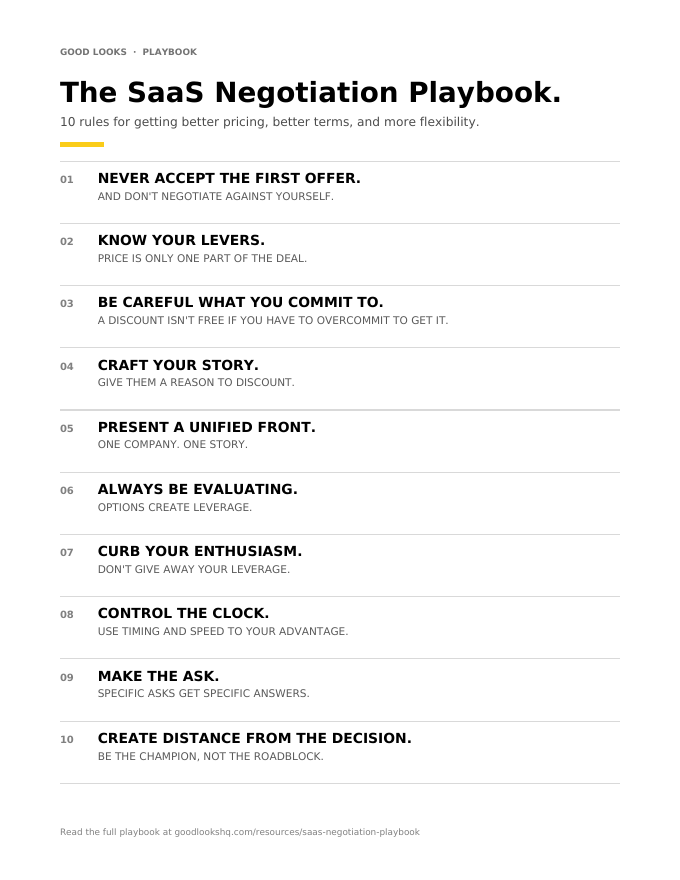
KEEP THE RULES HANDY.
We created a printable one-page companion to this playbook with all 10 rules of SaaS negotiation in one place.
Download it. Print it. Share it with your team. Keep it nearby for your next software purchase.
Download the rulesSummary
A practical guide to negotiating better SaaS contracts, built from years of experience on the other side of the table. Learn how software sales teams think, where your leverage comes from, and 10 simple rules for getting better pricing, better terms, and more flexibility on your next software purchase.
Introduction
Software vendors negotiate every day. Most buyers don't.
Software pricing is rarely as fixed as it looks.
The price on the website isn't always the price you'll pay. The first proposal isn't always the best proposal. And the biggest discount doesn't always mean you've negotiated the best deal.
This playbook was built from years spent on the other side of the table. selling SaaS, negotiating contracts, working against quotas, navigating discount approvals, and learning firsthand how software deals actually get done.
Now we're flipping the script.
We've taken those lessons and turned them into 10 practical rules designed to help buyers negotiate better software agreements.
Software vendors negotiate every day. Most buyers don't.
CONSIDER THIS YOUR PLAYBOOK FOR LEVELING THE PLAYING FIELD.
Rule 01
NEVER ACCEPT THE FIRST OFFER.
AND DON'T NEGOTIATE AGAINST YOURSELF.
This should go without saying, but you'd be surprised how often buyers accept the first proposal they receive.
Don't.
No matter how attractive the initial offer looks, treat it as a starting point. SaaS pricing frequently has flexibility, and the first proposal is rarely where the negotiation needs to end.
The same goes for your budget.
Salespeople are trained to ask what you're willing to spend. Whenever possible, don't be the first person to establish the number you're willing to pay.
If you're asked for your budget before you've seen pricing, you can simply say:
"We haven't established a firm budget yet. We're evaluating the market and trying to understand what a competitive package looks like."
Let the vendor establish their position before you establish yours.
DON'T SHOW YOUR HAND BEFORE YOU'VE SEEN THEIRS.
Rule 02
KNOW YOUR LEVERS.
PRICE IS ONLY ONE PART OF THE DEAL.
There's an old negotiation principle:
You can have your price and my terms, or my price and your terms. But you can't have both.
Ideally, you get both.
But every business has different priorities.
For one company, getting the lowest possible price might be most important. For another, it might be preserving cash, avoiding a long-term commitment, delaying the contract start date, or maintaining the flexibility to scale usage up or down.
Before you negotiate, understand which levers matter most to you.
PRICE
How much are you actually paying?
CONTRACT LENGTH
How long are you committing?
PAYMENT TERMS
When does the vendor get paid?
BILLING FREQUENCY
Monthly, quarterly, or annually?
START DATE
When does the contract and billing actually begin?
USAGE & SEATS
How much are you committing to buy?
SERVICES & SUPPORT
What implementation, training, onboarding, or support is included?
FLEXIBILITY
What happens if your needs change?
A lower price isn't necessarily a better deal if you have to give up everything else to get it.
KNOW WHAT YOU WANT. KNOW WHAT YOU'LL TRADE.
Rule 03
BE CAREFUL WHAT YOU COMMIT TO.
A DISCOUNT ISN'T FREE IF YOU HAVE TO OVERCOMMIT TO GET IT.
SaaS vendors love commitment.
More seats. More usage. Longer terms. Annual prepayment. Multi-year agreements.
And they'll often reward that commitment with better pricing.
That doesn't automatically make it a good deal.
A 25% discount on software you don't need is still wasted money.
The same applies to contract length. Don't sign a three-year agreement simply because the three-year price looks significantly better than the one-year price.
Ask yourself:
How confident are we that we'll still want this product at this level of usage two or three years from now?
If the answer isn't very, flexibility may be worth more than the additional discount.
If you do make a longer commitment, use it as leverage. Ask for something meaningful in return.
Treat every commitment as something you're giving the vendor.
Because it is.
COMMITMENT IS CURRENCY.
DON'T GIVE IT AWAY FOR FREE.
Rule 04
CRAFT YOUR STORY.
GIVE THEM A REASON TO DISCOUNT.
Discounts in SaaS are almost always available.
But there's an important distinction between asking for a discount and giving someone a reason to give you one.
Your reason can't simply be:
"We'd like to pay less."
Of course you would.
Salespeople are trained to defend price and overcome pricing objections. If you want them to make an exception, give them a business case they can take back to their manager.
Maybe:
A competitor has offered more favorable economics.
The investment is above your approved budget.
You're willing to move faster for the right package.
You're considering a larger deployment if the initial rollout is successful.
You're willing to adjust payment or contract terms.
Important functionality is still missing.
You're assuming additional implementation or adoption risk.
The specific story will depend on your situation.
But there should be a story.
Remember that the salesperson you're negotiating with may not have the authority to approve your request.
They may need to go to their manager, finance team, or deal desk and explain:
Why should we give this customer a better deal?
Give them the answer.
HELP THEM SELL YOUR DISCOUNT INTERNALLY.
Rule 05
PRESENT A UNIFIED FRONT.
ONE COMPANY. ONE STORY.
Large software purchases often involve multiple people.
Leadership. Finance. IT. Operations. Sales. Marketing. Procurement.
Vendors know this, and good salespeople will build relationships throughout your organization.
That's part of their job.
But every conversation can also reveal information.
Your budget. Your urgency. Your preferred vendor. Your internal politics. Your alternatives. Your decision criteria. Your willingness to walk away.
Before an important vendor conversation, make sure everyone internally understands the game plan.
Agree on:
What are our priorities?
What are our guardrails?
What are we willing to concede?
What information are we willing to share?
Who communicates with the vendor?
Who actually has final approval?
One stakeholder casually telling a salesperson:
"We absolutely love this. There's no way we're going with anyone else."
can undermine weeks of negotiation.
GET ALIGNED BEFORE YOU GET ON THE CALL.
Rule 06
ALWAYS BE EVALUATING.
OPTIONS CREATE LEVERAGE.
The easiest way to lose leverage in a negotiation is to have no alternative.
Even if you've already decided which vendor you prefer, continue evaluating credible competitors until the agreement is signed.
You don't need to lie.
You don't need to invent fake proposals.
And you don't need to pretend you hate the product you actually want.
Simply make it clear that the vendor still needs to earn your business.
"You're currently our preferred option, but we're still evaluating a couple of alternatives before making a final decision."
A legitimate competitive evaluation accomplishes several things.
It shows you've done your homework.
It helps you understand the market.
It gives you a benchmark for pricing and terms.
It keeps the vendor engaged.
And most importantly, it gives you somewhere else to go.
If another vendor moves quickly to meet your expectations, that creates pressure on your preferred vendor to respond.
THE BEST NEGOTIATING POSITION IS BEING WILLING TO WALK AWAY.
Rule 07
CURB YOUR ENTHUSIASM.
DON'T GIVE AWAY YOUR LEVERAGE.
Negotiations are a little like dating.
Sometimes it pays to play a little hard to get.
If a vendor knows their product is exactly what you need, you've already made your decision, and there's almost no chance you'll choose anyone else, they'll negotiate accordingly.
Don't confuse being professional and engaged with showing all of your cards.
You can love the product without saying:
"This is exactly what we've been looking for. We absolutely need this."
Instead:
"We like what we've seen. We're still working through the economics, alternatives, and internal requirements before making a final decision."
You're not being difficult.
You're maintaining optionality.
And you're reminding the vendor that getting from preferred option to signed customer still requires work.
INTEREST IS FINE. DESPERATION IS EXPENSIVE.
Rule 08
CONTROL THE CLOCK.
USE TIMING AND SPEED TO YOUR ADVANTAGE.
Timing matters in SaaS.
The salespeople you're negotiating with have quotas. Their managers have quotas. Their managers' managers have quotas.
Those targets are often measured monthly, quarterly, and annually.
That means the value of your signature can change depending on when you're willing to provide it.
Year-end can create leverage.
Quarter-end can create leverage.
Even month-end can create leverage.
But there's another clock that matters even more:
Yours.
Start evaluations as early as possible.
If your existing contract expires tomorrow and you desperately need a replacement, the vendor has the leverage.
If you've given yourself three months to evaluate your options, you do.
And when the timing is right, your ability to move quickly becomes another bargaining chip.
"We're prepared to move forward. If you can get us to $X and include Y, we can get this signed by Friday."
Now you're making a trade.
You give them: certainty and speed.
They give you: better economics or terms.
Never promise a signature you're not prepared to provide.
But when you're genuinely ready to buy, don't underestimate how valuable now can be to a salesperson trying to close a month, quarter, or year.
CONTROL YOUR TIMELINE. THEN USE THEIRS.
Rule 09
MAKE THE ASK.
SPECIFIC ASKS GET SPECIFIC ANSWERS.
Eventually, you have to ask for what you want.
A common mistake is being too vague.
"Can you do any better?"
Maybe.
But what does better mean?
Instead, make a clear and specific request.
"We'd like to move forward. If you can get the annual price to $X, include Y, and agree to Z, we can get this done."
Specific asks give the salesperson something concrete to take back internally.
And don't limit yourself to price.
Ask for:
A lower subscription price.
Additional seats.
Additional usage.
Waived implementation fees.
Training.
Premium support.
Delayed billing.
A later start date.
More favorable payment terms.
Some things may be much easier for the vendor to give you than others.
An extra 10% discount may require executive approval.
An additional training package might cost them almost nothing.
Understand your levers and build the package that creates the most value for you.
And when you're close to the finish line, don't be afraid of one final ask.
If you've managed the negotiation well, this is often the moment when the vendor has the greatest incentive to find a way to get the deal done.
BE BOLD. BE SPECIFIC. ASK FOR WHAT YOU WANT.
Rule 10
CREATE DISTANCE FROM THE DECISION.
BE THE CHAMPION, NOT THE ROADBLOCK.
One of the most useful negotiating positions is being able to put yourself on the same side of the table as the salesperson.
Instead of:
You vs. the vendor
create:
You + the vendor vs. the problem
For example:
"I want to get this done. I just need to get the final package through Finance."
Now the salesperson isn't defending their price against you.
They're helping you build a package that you can get approved.
This becomes particularly powerful when making a final ask.
"I think I can get this across the finish line, but I'm going to need something else to get Finance comfortable. If you can get us to $X, I think I can get the signature."
Even if you're a senior decision-maker, legitimate internal approval requirements can create useful guardrails.
A CFO.
A board.
A budget owner.
A procurement process.
A business partner.
Give the salesperson a concrete problem to help you solve.
GET ON THE SAME SIDE OF THE TABLE.
One more thing
The negotiation doesn't end when you sign.
The initial contract is only the beginning.
Renewals.
Additional seats.
New products.
Upgrades.
Additional business units.
More usage.
Every time you're giving the vendor more revenue or making an additional commitment, you have another opportunity to negotiate.
If you know you're likely to expand over time, resist the temptation to give everything away upfront.
Take the stair-step approach.
Buy what you need today.
Prove the value.
Expand when it makes sense.
And treat each additional commitment as a new negotiation.
Because the moment you say:
"We'd like to add another 50 seats."
you have something the vendor wants again.
COMMITMENT IS CURRENCY.
SPEND IT INTENTIONALLY.
Before you sign
The 10 rules of SaaS negotiation.
- 01NEVER ACCEPT THE FIRST OFFER.AND DON'T NEGOTIATE AGAINST YOURSELF.
- 02KNOW YOUR LEVERS.PRICE IS ONLY ONE PART OF THE DEAL.
- 03BE CAREFUL WHAT YOU COMMIT TO.A DISCOUNT ISN'T FREE IF YOU HAVE TO OVERCOMMIT TO GET IT.
- 04CRAFT YOUR STORY.GIVE THEM A REASON TO DISCOUNT.
- 05PRESENT A UNIFIED FRONT.ONE COMPANY. ONE STORY.
- 06ALWAYS BE EVALUATING.OPTIONS CREATE LEVERAGE.
- 07CURB YOUR ENTHUSIASM.DON'T GIVE AWAY YOUR LEVERAGE.
- 08CONTROL THE CLOCK.USE TIMING AND SPEED TO YOUR ADVANTAGE.
- 09MAKE THE ASK.SPECIFIC ASKS GET SPECIFIC ANSWERS.
- 10CREATE DISTANCE FROM THE DECISION.BE THE CHAMPION, NOT THE ROADBLOCK.
Remember who's sitting across the table.
Software sales teams negotiate for a living.
They understand how to uncover urgency, protect price, create competition, trade concessions, navigate decision-makers, and get agreements signed.
We know because we've sat on that side of the table.
This playbook takes what we've learned selling software and flips it in your favor.
You don't need to become a professional procurement negotiator.
You just need to understand the game well enough to play it.
Give yourself options.
Give yourself time.
Know what matters.
Know what you're willing to trade.
And never forget:
YOUR SIGNATURE HAS VALUE.
MAKE THEM EARN IT.